What Is a Salt Spray Test Chamber
You've probably had this happen on a project: a coating or a metal part looks flawless off the production line, gets shipped to a coastal client or a marine application, and within months it's rusting through. And now you're fielding warranty claims and explaining to a customer why a "corrosion-resistant" part corroded. A salt spray test chamber exists specifically to catch that failure before the part ever ships, not after.
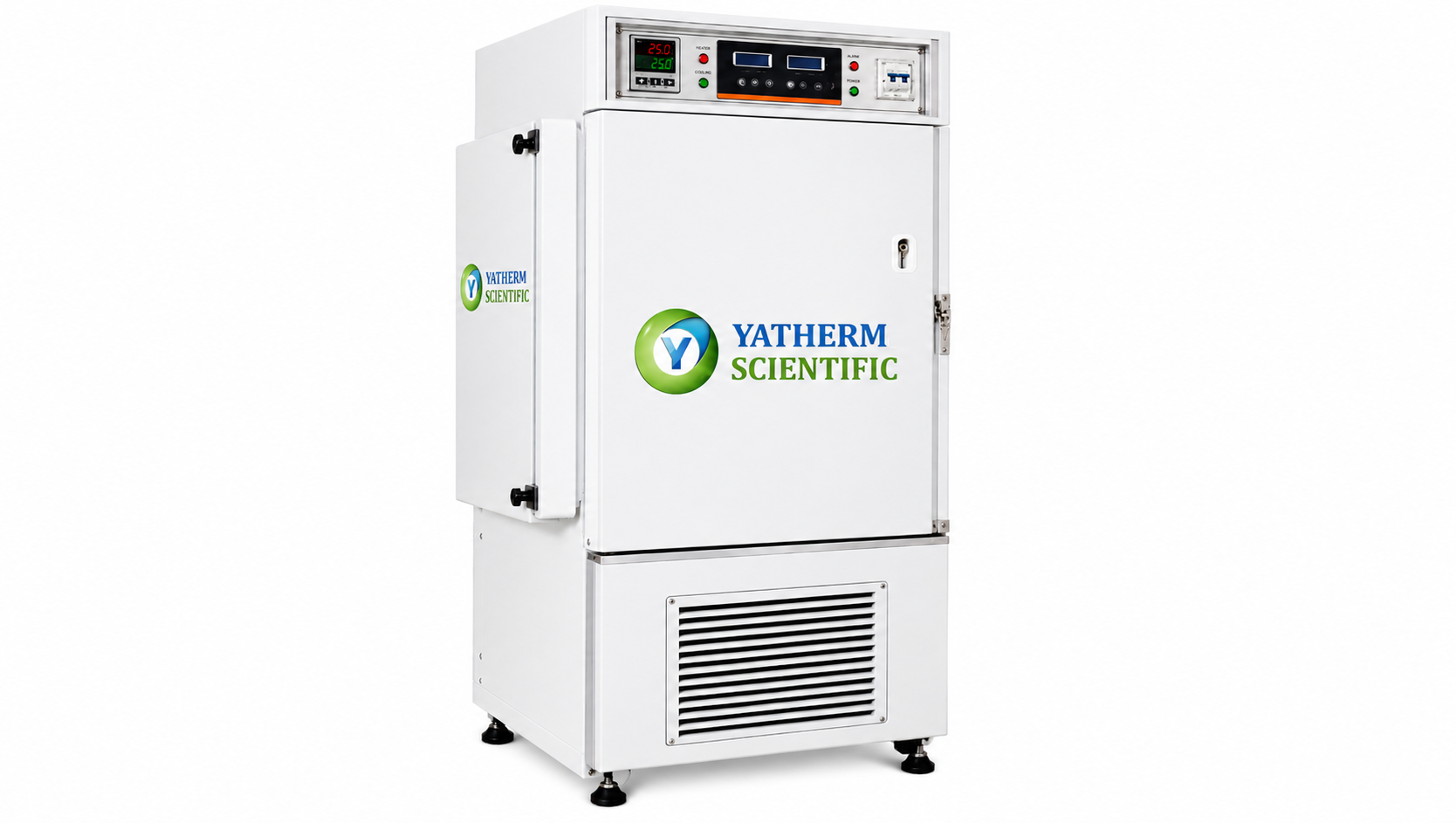
Yatherm's salt spray chamber is one of our most-selling products across the Indian and Asian markets, and for good reason — it's built to check the rust resistance of metal under moisture exposure, in a controlled, repeatable way. The chamber comes in four capacities from 100 to 4,000 litres, designed to EN ISO 9227 in complete SS 304 construction. It runs three programmed environments: salt spray, air drying, and high humidity at a controlled low temperature under 50°C, so you can move a sample through a full corrosion cycle without manually resetting conditions between phases.

Why This Test Matters Across So Many Industries
Yatherm's corrosion test chamber gives the most realistic and dependable corrosion test available, and it's widely used to test corrosion resistance across automotive, paint, surface coating, chemical, aerospace, electronics, offshore, and defense industries. A few build details that make it reliable rather than just functional:
- The chamber material is PVC/PP sheet, sturdy enough that it won't warp or lose shape over repeated humid cycles.
- The chamber is heated from five directions to keep temperature uniformly distributed rather than concentrated near one heating element.
- A specially made spray nozzle sprays saltwater at a controlled speed so it falls evenly across the sample surface.
- Hot, moist air keeps internal humidity matched to the exact testing requirement.
- A high-precision PID temperature controller holds the temperature difference within ± 0.1°C.
International Standards This Chamber Meets
A corrosion result only means something if it maps to a standard your customer or auditor recognizes. Yatherm's ASTM B117 salt spray test chamber is built to run:
- ASTM B117
- NSS (Neutral Salt Solution)
- ASS (Acetic Acid Salt Spray)
- SWAAT (Sea Water Acidified Test)
- CASS (Cupric Acid Salt Spray)
- Salt fog testing per DIN 50021
- Condensed water testing per DIN 50017
- Standard climates per DIN 50015

What's Actually Inside the Chamber
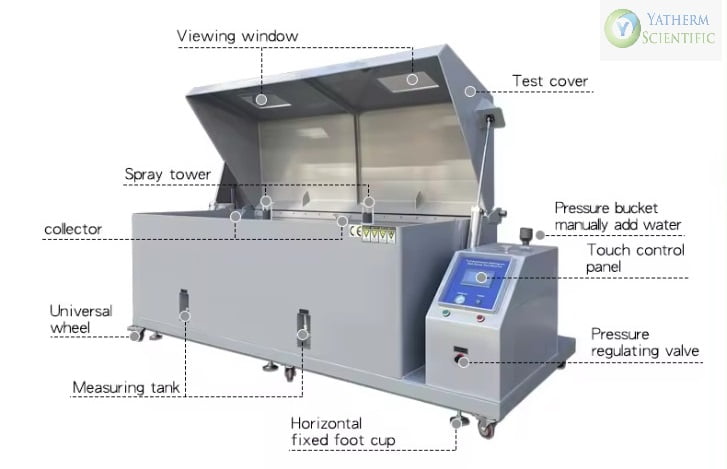
The test area uses high-quality glass fiber plastic with strong corrosion resistance, good plasticity, and long service life, along with high-temperature-resistant quartz nozzles that are easy to clean without blocking. An air circulation system keeps humidity and temperature uniform throughout the test area, and the water heating element sits at the bottom for effective, even heating.
The lid is made from imported acrylic transparent sheet — easy to handle, and it lets you view samples without disturbing the test environment. Long bar-type sample holders sit at the top of the chamber for hanging samples horizontally, and an optional air circulation system manages air cycling to maintain consistent humidity and temperature inside the closed chamber.


The atomizer tower produces a high-quality fog at 20 to 30 microns in a sturdy design, using a rust-proof atomizer tower and rust-proof quartz spray nozzles. The spray fog comes out very fine and uniformly distributed, which matters — an uneven spray pattern gives you inconsistent corrosion results across the same sample batch, and that inconsistency is exactly what a customer or auditor will flag first.
Construction is double-walled, with the inner chamber in SS 304, SS 316, or acrylic, and the outer shell in MS powder-coated steel or insulated SS 304 with high-density woolen insulation. This is also known as a corrosion test chamber, and it's equipped to run condensed water tests, CH3COOH (acetic acid) tests, salt spray tests, and cyclic corrosion tests, all through an advanced HMI with data logging, printer facility, USB port, and PLC control.
Control System and Solution Storage
You get two control options: microprocessor-based PID controllers, or PLC with HMI. The PLC option runs everything from one touch panel — data logging, timer, chamber temperature, and brine tank and air compressor control together. Where microprocessor-based PID controllers are used instead, the chamber runs two separate controllers — one for chamber temperature and one for brine tank temperature — along with a working-hour meter and a knob-type controller for air compressor pressure.
Spray nozzles are built to DIN standard, and solution storage uses a nonmetal tank with its own heating facility and input water connection, supplied alongside the equipment for guaranteed compatibility rather than sourced separately.
Who Actually Runs Salt Spray Testing
Salt spray and corrosion testing shows up across aerospace, electronics, automotive, paint and coating testing, hardware tools testing, medical equipment, marine, aerospace testing equipment, material testing, railway testing labs, defense research labs, and general engineering. If your lab also runs UV or weathering trials alongside corrosion testing — which is common for automotive coatings and outdoor electronics — it's worth looking at our UV weathering test chamber range too, since a lot of customers end up needing both to fully characterize a coating's durability.
As a leading salt spray test chamber manufacturer in India, Yatherm builds across the full capacity range from 100 to 4,000 litres, and we're happy to walk you through which capacity and standard combination (NSS, ASS, CASS, or SWAAT) actually matches your test protocol before you commit to a size. If you'd rather talk it through than read another spec sheet, reach out to our team directly.
Frequently Asked Questions
1. What's the difference between a salt spray chamber and a corrosion test chamber?
They're the same category of equipment — "corrosion test chamber" is the broader term, while "salt spray chamber" refers specifically to units running NSS, ASS, CASS or similar salt-fog test methods.
2. What standards does Yatherm's salt spray chamber comply with?
ASTM B117, NSS, ASS, SWAAT, CASS, and DIN 50021, 50017, and 50015.
3. What capacities are available?
From 100 litres up to 4,000 litres, covering the Atomizer-350 through Atomizer-1000 range and beyond for larger test volumes.
4. What temperature range does the chamber operate in?
30°C to 60°C, with test chamber temperatures held at 35°C ± 1°C for NSS/ACSS and 50°C ± 1°C for CASS testing.
5. What's the spray quantity and air pressure specification?
Spray quantity runs 1.0 to 2.0 ml per 80 cm² per hour, with air pressure held at 1.00 ± 0.01 kg/cm².
6. What's the chamber construction material?
Double-walled FRP construction with a corrosion-resistant FRP internal chamber and an acrylic or PVC lid with pneumatic operation on larger models.
7. Can this chamber run more than one type of corrosion test?
Yes — it handles Neutral Salt Spray, Acetic Acid Salt Spray, Cupric Acid Salt Spray, and condensed water testing depending on your protocol.
8. What's the pH control range?
6.5 to 7.2 for Salt Spray Method (NSS/ACSS) and 3.0 to 3.2 for the Corrosion-resistant Testing Method (CASS).
9. Does Yatherm offer after-sales support and certification?
Yes — chambers are CE certified, and Yatherm provides technical support, installation guidance, and validation documentation on request.
If you're not sure which capacity or test standard fits your material and application, talk to our team with your sample size and the standard your customer or industry requires — we'll help you land on the right configuration instead of guessing off a brochure. And if a corrosion failure has slipped past your QA process before, tell us about it in the comments. It's the kind of detail that saves the next person a very expensive recall.